
Listening, Remembering and Looking Ahead
As Mirabilis Collective closes 2025, Artistic Director Stephanie Nicholls reflects on a year shaped by listening, collaboration, and connection. This article traces the projects, partnerships, and conversations that defined the year, introduces our forthcoming FRINGE WORLD debut in 2026, and looks ahead to the longer arc of Hear Her Now — our debut chamber music festival dedicated to music written by women.
Closing 2025 and Making Our FRINGE WORLD Debut
As the year draws to an end and we look ahead to a significant new chapter for Mirabilis Collective, I wanted to share some reflections on the work that shaped 2025 and the ideas guiding us into 2026.
Throughout 2025, we found ourselves reflecting on a year shaped by listening — to stories that have been overlooked, to voices that deserve more space, and to the communities who continue to meet our work with generosity and curiosity.
This moment of reflection also coincides with an important milestone for Mirabilis Collective. In early 2026, we will make our FRINGE WORLD debut, presenting two contrasting works that sit at the heart of our artistic practice.
2025 was a year defined by depth, collaboration and connection. Across the year, Mirabilis Collective continued to build work that brings music, story and people into close conversation.
We began the year with Her Sound, Her Story for International Women’s Day, a landmark project that brought together Mirabilis Collective and 160 students from Methodist Ladies’ College, St Mary’s Anglican Girls’ School, and St Hilda’s Anglican School for Girls. Through rehearsal, collaboration and performance, students worked alongside professional musicians to bring women’s music to life on a large scale. The project exemplified our commitment to intergenerational music-making and to creating meaningful performance experiences for young women at a formative stage of their musical lives.
In April, we were honoured to present Sounds of Her as part of the Boorloo Heritage Festival, continuing our collaboration with Perth Wesley Church during celebrations marking the church’s 155th anniversary. The program situated music by women within a broader reflection on place, history and community.
Education and mentorship were also key threads throughout the year. Our residency at Christ Church Grammar School allowed us to work closely with students over an extended period, sharing repertoire, rehearsal processes and professional insights. Spending time in the classroom and rehearsal room reinforced the value of sustained engagement, and the energy, curiosity and commitment of the students made this residency particularly rewarding.
Collaboration continued to shape our creative work. Finding Connie grew through close work with UWA composition students, whose creativity and insight added new layers to the project. We were also delighted to be invited to present a feature performance at the APSMER Conference, sharing our work with music educators and researchers from Australia and the Asia–Pacific region.
Our concert program expanded in both scope and ambition. Clara Schumann: Notes from an Extraordinary Life brought together chamber music and narrative in a deeply personal portrait, featuring Opera Australia star Annie Aitken, alongside outstanding young musicians Ellie Malonzo and Jessica Casey. The generosity and artistry of everyone involved made this project especially meaningful.
We were also proud to present our community concert debut, Listening Room, made possible with the support of the City of Stirling. This new format allowed us to reimagine how audiences encounter chamber music, creating an intimate, welcoming space for listening and conversation.
Southern Stars was a celebration of contemporary Australian women composers and songwriters, featuring a world premiere composition by Katherine Potter and live on-stage conversations with ABC Radio’s Joanna Trilling. The dialogue between music, ideas and lived experience sat at the heart of this event.
We were honoured to present the final concert in the Winter Series for Grove Classics, celebrating the series’ 15th anniversary at The Grove Library in Peppermint Grove. Grove Classics has long been recognised for its intimate, accessible concerts and its carefully curated programs, making it a special context in which to share our work.
Across all of these projects, one of the great joys of 2025 was the chance to connect with audiences beyond the performance itself — sharing conversations, reflections, and, more often than not, bubbles and brownies after the concert. These moments of informal exchange continue to shape how we think about community, hospitality and the role of live performance.
This moment of reflection also coincides with an important milestone for Mirabilis Collective. In early 2026, we will make our FRINGE WORLD debut, presenting two contrasting works that sit at the heart of our artistic practice.
FRINGE WORLD 2026: Our Debut Season
Our FRINGE WORLD debut brings together two works that approach women’s stories from different perspectives, while sharing a common impulse: to listen closely and to give voice.
Finding Connie: Songs of a Lost Genius appears in a new cabaret-style version for sextet, featuring newly created arrangements by Julia Nicholls. This 60-minute concert-theatre work explores the life and music of Connie Converse, a pioneering singer-songwriter whose work largely disappeared from public view during her lifetime. Through live performance and narration, the show traces Connie’s songs alongside the mystery of her disappearance, inviting audiences to reflect on recognition, creativity, and what it means to be heard.
Alongside this, She Said What? offers a contemporary counterpoint. This hour-long performance presents a curated selection of outstanding songs by Australian women songwriters, heard through intimate acoustic reimaginings. Drawing on music that ranges from reflective to defiant, the program foregrounds women’s words and the clarity that comes from stripping songs back to their essence.
Together, these two works mark an exciting first step for Mirabilis Collective at FRINGE WORLD, and an opportunity to share our approach to storytelling and live performance with new audiences.
Looking Ahead: Hear Her Now
Much of what Mirabilis Collective has been building over recent years now comes into focus through our next major chapter: Hear Her Now.
Launching in October 2026, Hear Her Now is a chamber music festival celebrating music written by women — across genres, generations, and stories. From early music to contemporary voices, the festival brings together performance, storytelling, education, and community engagement, led by an intergenerational ensemble of professional women musicians.
Hear Her Now represents a natural evolution of our artistic vision: deepening our commitment to amplifying underrepresented voices, building audiences, and creating meaningful connection through music. We’re excited to begin sharing the story of the festival, with further program details to be announced in 2026.
We invite you to explore Hear Her Now on our website and follow the story as it unfolds.
Regional Momentum
We are delighted to share that Mirabilis Collective has been awarded a Synergy Community Giving Fund Grant, supporting the next stage of Her Sound, Her Story through performances and community engagement in Narrogin and Wagin.
This funding enables us to extend our regional work through residencies, workshops and collaborations with local choirs and young women musicians. Attending the award ceremony was a meaningful moment for our team, and we are grateful for support that recognises the value of long-term, place-based engagement.
As we close the year, we do so with a strong sense of continuity. From revisiting lost voices, to amplifying contemporary ones, to deepening relationships with regional communities, the through-line remains clear.
We look forward to making our FRINGE WORLD debut in 2026, and to sharing what comes next.
Thank you for being part of the journey.
Hear Her Now marks the next major chapter in Mirabilis Collective’s work. You can explore the festival and follow its development on our website as we share more over the coming months.
About the Author
Stephanie Nicholls is the Artistic Director and founder of Mirabilis Collective, an oboist, pianist, and advocate for women in music. She founded the ensemble in 2022 to champion works by women composers and mentor young women musicians entering the profession.
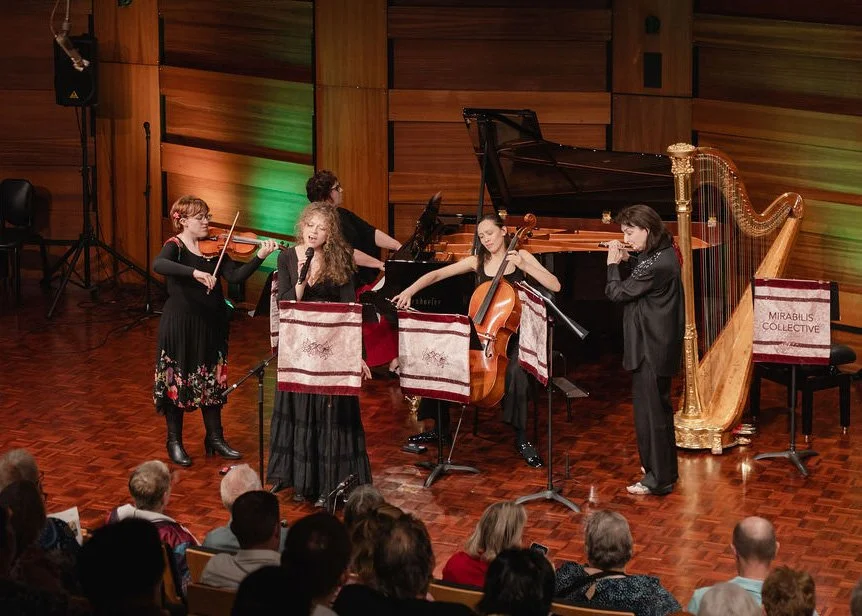
L–R: Julia Nicholls, Lucinda Nicholls, Stephanie Nicholls, Elena Wittkuhn, and Tresna Stampalia of Mirabilis Collective perform at Southern Stars — a celebration of contemporary chamber music written Australian women.
Photo credit – Tallulah Chong

AusArt Day: Why This Matters for Every Australian Arts Organisation—Including Ours
As Mirabilis Collective prepares for Australia's inaugural AusArt Day on October 23rd, Artistic Director Stephanie Nicholls reflects on a fundamental question: How do we build and sustain arts organisations when the median music artist income is just $14,700 annually? This article explores the structural differences between Australian and American arts philanthropy, reflects on our journey from volunteer-run ensemble to registered charity, and explains why this collective moment matters for every organisation—and every Australian who values beauty, connection, and meaning in their lives.
This month, as Australia celebrates its first-ever AusArt Day, I wanted to share some reflections on what this national movement means for organisations like Mirabilis Collective—and for the future of the arts in Australia.
As Mirabilis Collective prepares to participate in Australia's inaugural AusArts Day on 23 October, I find myself reflecting on a question that has occupied my thoughts since founding this organisation: How do we build and sustain arts organisations in Australia when the structural supports for philanthropy are so fundamentally different from those in countries where arts giving thrives?
The answer, I believe, begins with understanding the challenge—and then taking collective action to address it.
The Crisis We're Not Talking About Loudly Enough
According to Creative Australia, only one in five professional artists in Australia this year will make $48,000—deemed the minimum livable wage—by working in the arts. On average they will earn $23,000 from their artistic work and only $54,000 when all their other non-artistic jobs are added in.
Let that sink in. The professionals creating the culture that defines us are earning, on average, less than half the minimum livable wage from their actual artistic work.
As Belvoir St Theatre's Artistic Director Eamon Flack wrote recently in The Guardian, "Smaller cast sizes, fewer productions, less artistic variety, diminished cultural reach, fewer jobs for artists: that's the business model now." He describes the eternal choice facing every arts organisation: "beef up the artistic task and go broke, or diminish the artistic task and stay solvent."
For Australian arts organisations in 2025, this is daily reality.
The system hasn't been comprehensively rethought since Helen Nugent's Major Performing Arts Inquiry in 1999. That inquiry reviewed 31 major performing arts organisations and arose out of a perceived crisis in the sector—costs were spiralling while revenue was declining due to globalisation, technological change and demographic shifts. Sound familiar?
The report's 95 recommendations were accepted by the Australian government. An extra $70 million was injected into the sector by federal and state governments. The recommendations were designed to create a cohesive structure for the industry, strengthen private sector support, improve accountability, and secure the sector's artistic vitality and financial viability.
Yet despite the introduction of the majority of these changes, the overall wellbeing of major performing arts companies has not markedly improved. The world has changed dramatically, but the performing arts in 2025 are still operating on Windows 99—and facing eerily similar challenges to those the Nugent report tried to address 26 years ago.
What America Gets Right About Arts Giving
While Australia's arts sector struggles with 25-year-old policy settings, let's look at what's happening elsewhere.
The United States is home to over 1.5 million registered charities with giving reaching an estimated $499 billion in 2023, representing about 2.1% of GDP. In contrast, Australia has around 60,000 registered charities with annual giving estimated at $13 billion AUD—less than 1% of GDP.
Scale tells only part of the story. The structural differences run even deeper. As fundraising consultant Stephen Mally observes:
“US donors benefit from a well-known charitable deduction that reduces taxable income, often incentivising major gifts. The process is familiar and built into annual financial planning, especially for high-net-worth individuals.
In Australia, while donations over $2 to deductible gift recipients (DGRs) are tax-deductible, the incentive is less aggressively promoted or integrated into wealth planning. Furthermore, estate and inheritance tax advantages that drive bequests in the US are absent in Australia.”
Tax systems reflect policy priorities, and the American approach—for all its imperfections—has historically embedded arts philanthropy into financial planning in ways that Australia hasn't. This doesn't mean the US model is perfect or that we should simply copy it. But it does suggest there's untapped potential in how we structure incentives for cultural giving in Australia.
The DGR Journey: A Necessary Hurdle
I speak from experience here. Mirabilis Collective is now a registered charity with DGR status—a milestone we achieved thanks to the extraordinary tenacity of Luke Donohoe from Culture Labs, who guided us through the complex process.
Becoming endorsed as a deductible gift recipient can be a long and challenging process. Since December 14, 2021, registration as a charity with the Australian Charities and Not-for-profits Commission has been a precondition for DGR endorsement for all non-government DGRs. Organisations must first establish their charitable status, then meet specific requirements for cultural organisations, including maintaining a gift fund with appropriate clauses.
Having achieved DGR status, we can now offer donors tax deductibility for their contributions. But the journey highlighted a crucial reality: Australian organisations tend to take a more conservative, sometimes risk-averse approach to fundraising. Fundraising teams are often smaller and operate with tighter budgets. For volunteer-run organisations or small collectives, the DGR pathway—while essential—can be prohibitively complex without expert assistance.
For artists and organisations without DGR status, the Australian Cultural Fund provides an alternative pathway. Managed by Creative Australia, it enables artists to raise tax-deductible funds for their projects through a fee-free platform. It's an important resource, particularly for independent artists and small organisations that either don't yet have, or due to their structure don't qualify for, DGR endorsement.
Tax Reform: Necessary But Not Sufficient
Across Australia, conversations are happening about tax reform for the arts. While NSW has recently convened a summit on the topic, these are national issues affecting all of us.
The newly released Bass Line report from Music Australia reveals the median music artist income is just $14,700 per year. Even more stark: approximately 82% of Australian artist income is earned by the top 25% of income earners. For the vast majority of musicians, sustaining a career is financially untenable.
The current system creates perverse outcomes. Artists must pay income tax on prizes and grants—the rare windfalls meant to sustain their practices. While the median music income is $14,700, most artists supplement this with non-arts work to survive. When a $5,000 prize pushes their total income into a higher tax bracket, a significant portion disappears to tax—diminishing the very support mechanism designed to help sustain their artistic practice.
Reform proposals include clearer deductibility arrangements for freelance artists, better rates to encourage donors, fringe benefits tax concessions, and tax exemptions for grants and awards. These could save many organisations from going broke.
But as Eamon Flack pointedly asks: "Is solvency really the best we can hope for when it comes to the artistic and cultural life of the country?"
The real goal of arts policy shouldn't be to keep organisations solvent; it needs to keep each artform alive for the next generation.
Tax reform addresses symptoms. But the disease is deeper: a fundamental undervaluing of artistic work in Australian society.
Why AusArt Day Is a Watershed Moment
AusArt Day, taking place on Thursday 23 October, invites all Australians to show their support for artists and arts organisations by making a donation—big or small, to support the creativity they love. More than 330 artists and arts organisations have signed up to take part in the inaugural celebration.
Creative Australia is supporting AusArt Day, contributing $500,000 in microgrants upfront, alongside resources, workshops, and advertising materials to help participants prepare fundraising campaigns. Mirabilis Collective was privileged to receive a $5,000 grant to enable us to engage a videographer to create our campaign video. We also held an event with some of our wonderful supporters to launch the campaign, which was a beautiful celebration of what we've achieved and where we're heading.
What makes this significant isn't just the coordinated fundraising effort—it's the collective consciousness-raising. For one day, the entire Australian arts sector will speak with one voice about the importance of private support for creativity. Beloved names including singer Kate Miller-Heidke, actor Rob Collins, Collingwood AFL captain Darcy Moore, and actor Angourie Rice are among the heavy hitters lending their voices to the campaign.
This visibility matters enormously. Australian arts organisations operate in a context where most organisations are stuck between the rock of structural deficit and the hard place of artistic purpose, where government funding comes and goes with budget cycles, and where—unlike our American counterparts—we can't easily leverage the sophisticated tax planning mechanisms that drive transformational gifts in the US.
It reminds Australians why they value the arts, as sources of beauty, connection, and meaning in their daily lives. When funding models fail, it's not just organisations that suffer; it's every person who turns to live music for stress relief, for social connection, for the experience of beauty that makes life richer.
AusArt Day creates something we've desperately needed: a cultural moment that normalises arts giving and positions it as a civic responsibility, not an optional luxury.
"Take Enough Pieces Off a Plane and It's Just a Bus with Wings"
Eamon Flack uses a devastating metaphor: "Take enough pieces off a plane and it might still look like a plane, but if it can't fly it's just a bus with wings."
We cannot trade off any more than we already have without risking the basic purpose of the arts. Every dollar not spent on artists making art contributes to the growing loss of knowledge, purpose, virtuosity and livelihood that are the lasting currency of these artforms. If so few dollars continue to flow to the creatives, there will be no artists or art left in the arts.
This reality occupies my thinking constantly as I consider Mirabilis Collective's future.
From Volunteer-Run to Sustainable: The Mirabilis Journey
I founded Mirabilis Collective after serving as national syllabus consultant for the Australian Examinations Music Board, updating the oboe syllabus with a more diverse repertoire. That work opened my eyes to a glaring gap in our sector: the systematic under-representation of works by women composers on Australian stages and in teaching syllabuses. If young musicians never see themselves reflected in the repertoire, how do they imagine their place in the profession?
But there was another gap too. Conversations with my Mirabilis colleague Tresna Stampalia crystallised something we'd both experienced: young women musicians on the cusp of professional careers needed knowledge, support, and affirmation in a safe environment. They needed mentors who could help them navigate a profession that wasn't always designed with them in mind.
As a mother of two professional musician daughters, I've witnessed firsthand the challenges facing emerging artists. I've seen talented young women question whether they can sustain careers in music when the economics are so brutal. The mentoring Tresna and I had provided informally—drawing on our own hard-won experience—needed to become intentional and ongoing. But building a sustainable organisation while remaining true to our mission—addressing both repertoire equity and artist mentorship, and doing so largely through volunteer labour—has required constant innovation and, frankly, sacrifice. That same commitment to mentorship now drives our vision to evolve from a volunteer-run ensemble to a sustainable organisation with the capacity to commission new works, employ musicians fairly, and mentor the next generation.
The journey to DGR status was essential but demanding. Luke Donohoe guided us through the process—navigating the ACNC registration, establishing proper governance structures, creating the gift fund with appropriate clauses, and ensuring we met all the requirements for cultural organisations. Without his expertise, we would have struggled to achieve this crucial milestone.
Now, with DGR status, we can offer donors tax deductibility for contributions over $2. This is significant—but it doesn't change the underlying economics. Chamber music ticket sales rarely cover costs. Government grants are increasingly competitive. And while we can now attract donors who value tax deductibility, we're still operating within a system that provides fewer incentives than comparable countries.
Our campaign for AusArt Day, "Let Her Be Heard," supports our goal to perform 100 works by 100 women at Hear Her Now: A Festival of Women in Chamber Music. This programming actively reshapes the canon, provides role models, and creates opportunities for women composers whose work has been systematically excluded from performance.
But the questions persist: How do we fund this work sustainably? How do we pay the artists who mentor generously with their time and expertise? How do we grow from volunteer-run to professionally staffed without losing our soul? How do we avoid sacrificing artistic ambition just to stay solvent?
As Eamon Flack reminds us: "Artistic talent doesn't spontaneously come to fruition. The knowledge and craft that makes an artist is passed down from the generation before. A good artist needs as much lifelong training and practice as a good sportswoman."
This work—mentoring young women musicians, commissioning and encouraging works by emerging women composers, creating safe spaces for artistic development—requires sustainable funding. The intergenerational transfer of knowledge depends on it.
The Opportunity Before Us
AusArt Day won't solve Australia's structural arts funding crisis overnight. It won't transform our tax system to match America's incentives. It won't make the DGR application process simpler for organisations still navigating it. It won't address the policy settings that haven't been meaningfully updated since 1999.
But it does something arguably more important: it normalises the ask. It creates visibility and builds community.
As Creative Australia Chair and AusArt Day Ambassador Professor Wesley Enoch AM said: "It really makes a difference when your community gets behind you. AusArts Day is a chance for Australians to show their support by getting behind the musicians, painters, dancers, actors, singers, sculptors, writers and all the creative people who make our country so vibrant and fun to be a part of."
For Mirabilis Collective, this day represents validation of what we've always known: the arts matter, not as entertainment luxury but as essential nourishment for civic life. Every young woman we mentor, every work by a woman composer we perform, every barrier we break down—this work has value beyond what can be captured in grant applications or box office receipts.
There is untapped potential to grow the giving economy in Australia. The challenge is to normalise large-scale giving through structured stewardship, major donor programs, and cultural shifts that celebrate philanthropy.
That cultural shift begins with conversations like this one—and with collective action like AusArt Day.
What's at Stake
Eamon Flack uses a sports metaphor that should haunt us all. The West Indies used to be the greatest cricket team in the world, with legendary performances. But years of underfunding and neglect of grassroots development decimated their system. Two months ago, Australia bowled out the entire West Indies team for 27. "If we leave the country's arts policy settings as they are, we'll be bowling ourselves out for 27.”
What's at stake is the survival of artforms that take lifetimes to master and generations to pass on.
In 20 years, will Australians still have access to the live music that offers stress relief after difficult weeks, the beauty that provides respite from digital overload, the shared experience of a concert that counters isolation? Will women composers have their works performed? Will young artists be able to imagine sustainable careers creating what they love and what society needs?
What This Means for You
Whether you're someone who turns to live music when life feels overwhelming, who finds connection in shared cultural experiences, who values beauty in an increasingly utilitarian world—or whether you're an arts organisation wondering if this coordinated effort will make a difference, or a donor considering where to direct your support—AusArt Day matters.
It matters because it says: we're not waiting for tax reform to be enacted (though we desperately need it). We're not waiting for government funding to stabilise (though it must). We're not waiting for the policy settings to be updated from 1999 (though they're catastrophically outdated).
We're building a movement of Australians who understand that supporting the arts is supporting the soul of our nation—and the livelihoods of the artists who create our culture.
For Mirabilis Collective, this day is both practical—we need funds to deliver our 2026 festival and compensate our artists fairly—and symbolic. We're part of something larger than ourselves. We're on Creative Australia's participant gallery standing alongside organisations from every corner of this country, each telling their own story about why creativity matters and why it's worth fighting for.
AusArt Day is our chance to prove that collective action can begin to address a crisis that's been 25 years in the making. It won't solve everything. But it's a start.
And in a sector where musicians are earning $14,700 annually from their creative work, where orchestras are reducing positions, where chamber music groups program only the safe classics, where works by living composers—particularly women—go unperformed—we need to start somewhere.
Will you be part of it?
On Thursday October 23, Mirabilis Collective will join hundreds of organisations for AusArt Day — a nationwide moment of unity and generosity for the arts. If you believe women’s voices deserve to be heard and celebrated, please visit mirabiliscollective.com/support-us to make your tax-deductible donation and help us reach 100 works by women performed at our Hear Her Now Festival.
About the Author
Stephanie Nicholls is the Artistic Director and founder of Mirabilis Collective, an oboist, pianist, and advocate for women in music. She founded the ensemble in 2022 to champion works by women composers and mentor young women musicians entering the profession.

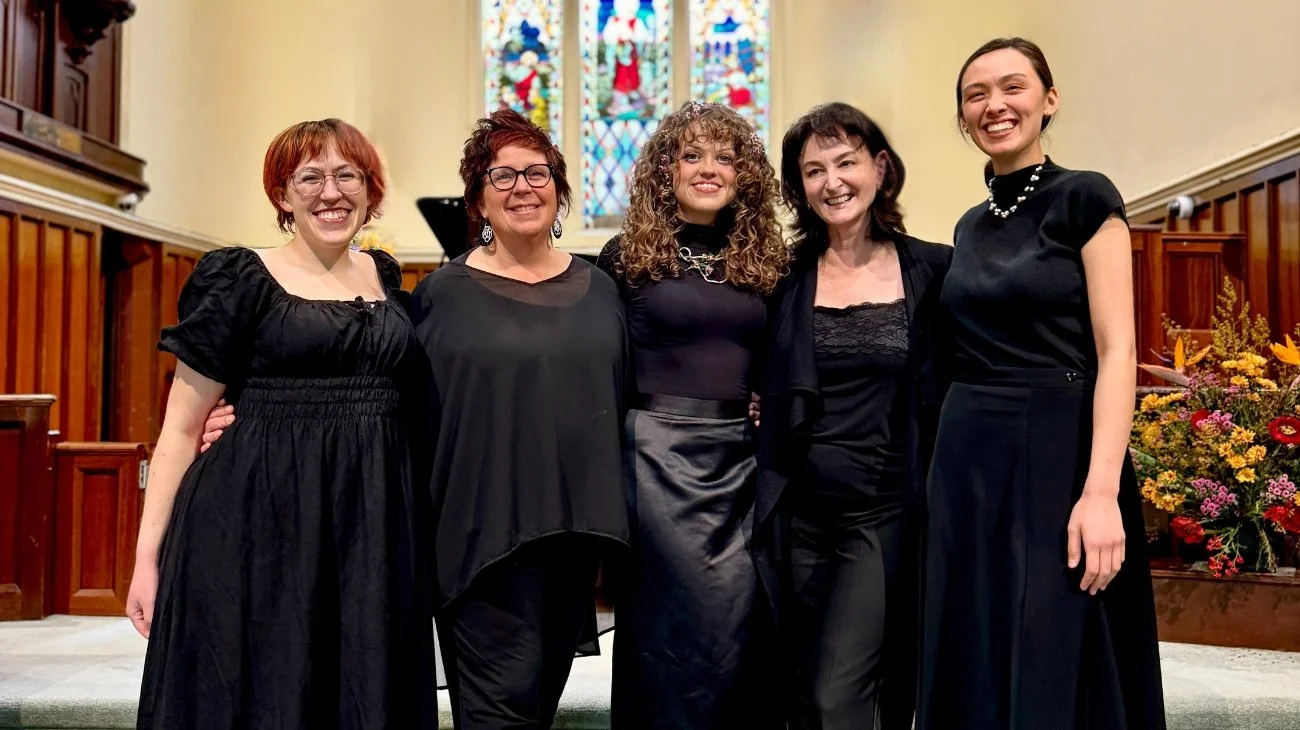
L–R: Julia Nicholls, Stephanie Nicholls, Lucinda Nicholls, Tresna Stampalia, and Elena Wittkuhn of Mirabilis Collective at the AusArt Day Launch Let Her Be Heard — a celebration of women’s voices, creativity, and community in music.
Photo credit – Perth Classical Music Events